
How to Identify British Songbirds by Song: A Beginner's Audio Guide
How to Identify British Songbirds by Song: A Beginner's Audio Guide
Stand at the end of a garden on a still May morning and you might hear fifteen birds singing at once. That wall of sound is where most beginners give up. The trick is not to learn it all at once, but to pull one voice out of the chorus and know it for certain. A handful of common birds account for most of what you hear, and each has habits — where it sings, when it sings, how often it repeats itself — that give it away before you have even seen it. The good news is that you do not need a perfect ear or a degree in ornithology. You need patience, a few repeated visits to the same patch, and a willingness to stand still for longer than feels comfortable.
Song or call? Know which one you're hearing
Before anything else, separate song from calls. Song is the long, structured performance you get from males in the breeding season, roughly from late winter through to midsummer. It is delivered from a perch or in flight, and it is aimed at two audiences: a mate and a rival. Calls are the short, blunt noises birds make all year — contact notes between a pair, alarm notes when a cat walks past, the ticking of a robin in a hedge.
Calls are often easier to learn and just as useful. A great tit's sharp "pink", a blue tit's thin "see-see", the clattering panic of a blackbird. Plenty of beginners hear a blue tit's call, file it away as a song, and then wonder why nothing matches. Working out which category you are listening to halves the list of candidates straight away. If the sound is repetitive and seems to go on for minutes, you are probably hearing song. If it is a single note or a short burst, repeated at irregular intervals, think call. And do not ignore the alarm calls: they will tell you when a sparrowhawk is about long before you see it.
Start with the seven voices you'll hear most
Pick a morning in late April in a town garden, a park or a hedgerow and these are the birds doing most of the work. Learn them first; everything else gets easier once these are secure.
- Blackbird — low, rich and unhurried, with fluting phrases delivered one at a time and long pauses between them. That hesitation is the signature. Often sings from a rooftop or treetop, and again at dusk. The notes have a mellow, woody quality, as if someone is playing a flute in no particular rush.
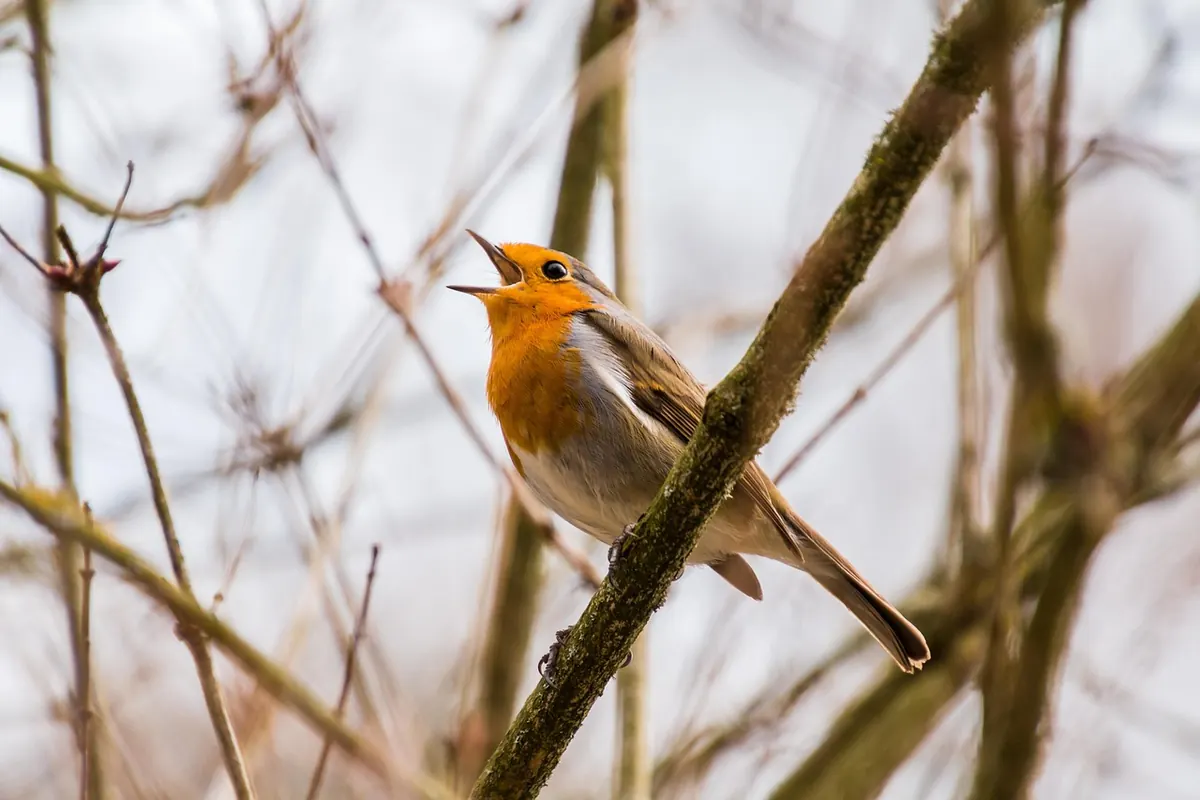
- Robin — sweet, high and slightly wistful, a trickle of clear notes with pauses that make it sound thoughtful. Sings all year, often from deep cover, sometimes at night under street lighting. In winter, both males and females sing, which is unusual among British birds.
- Song thrush — clear, carrying phrases, each one repeated two or three times before the bird moves on. The repetition is the giveaway. Listen for it from a high perch at dawn and dusk. It can sound like a musician practising scales, deliberately going over the same phrase before trying the next.
- Wren — startlingly loud for a bird the size of your thumb: a hurried torrent of notes ending in a hard, rattling trill. Usually low down, tail cocked, often in ivy or the base of a hedge. You often hear it before you see it, and the volume can make you look for something much larger.
- Great tit — the classic two-note "tea-cher, tea-cher", like a squeaky bicycle pump. But it has a large repertoire and also produces a metallic, seesawing "teacher-teacher" and a high, thin "si-si-si". If you hear something that sounds almost like a great tit but slightly wrong, it probably is one.
- Blue tit — a thin, high "see-see-see" or a trilling "tsee-tsee-tsee" that can sound like a tiny bell being rung. Often in trees and bushes, constantly on the move. Its song is easily overlooked because it is so high-pitched; listen for a rapid, slightly wheezy jingle rather than a full-throated melody.
- Chaffinch — a confident, cascading song that often ends in a flourish or a "pink" note. Think of a bowler running up and releasing the ball: a series of accelerating notes then a final flick. Sings from exposed branches in parks and woodlands, and its call is a sharp "pink".
Once these seven are familiar, you can start adding others. The dunnock's quiet, rapid warble is easy to miss; the blackcap's rich, fluting song can be mistaken for a robin but is more sustained; the goldfinch's tinkling twitter is bright and social; and the woodpigeon's five-note coo — "my toe bleeds, Betty" — is one of the easiest of all to learn. But do not rush. Two or three new songs a week is plenty.
Listen by habit, not just by sound
One of the most useful beginner's tricks is to note where a bird is singing and when. A song thrush repeats phrases from a high, exposed perch. A wren rattles from deep in a hedge. A robin sings from the middle of a bush, often half-hidden. A chaffinch sings from the top of a tree and then moves. A blackbird sings from a chimney pot or television aerial at dusk. The same voice can sound different in different places, but the address narrows the options fast.
Ask not only "what does it sound like?" but "where is it, and what is it doing?" A bird's habits are half its identity.
Timing matters too. The dawn chorus is loudest in the first hour after sunrise, but not every bird joins at once. Robins and song thrushes often start before sunrise; blackbirds and great tits join soon after; wrens and blue tits tend to come later. If you can get out at the same time for a week, you will start to hear the order of the choir, and that order itself becomes a clue.
A simple practice routine for the first few weeks
Birding by ear is a skill, not a talent. Like any skill, it responds to short, regular practice. Try this routine:
- Choose one small patch — a garden, a park corner, a short stretch of hedgerow — and visit it at the same time three or four mornings a week.
- Stand still for five minutes without looking at your phone. Let the chorus settle around you.
- Pick out one voice. Follow it until you can hum or whistle a rough version of it.
- Find the bird if you can, and watch what it does while it sings. Note the perch height and the rhythm.
- Write down three things: the sound, the place, the time. A simple notebook beats a memory.
- Compare what you heard with a recording later that day. Apps such as Merlin or BirdNET can suggest an identification, but treat them as hints, not verdicts.
- Do not try to learn more than two new songs a week. Repetition beats binge-listening.
Common confusions and how to sort them
Most beginner mistakes come from a small group of similar sounds. Here are the ones that trip people up most often:
- Blackbird or song thrush? The blackbird pauses between phrases; the song thrush repeats each phrase two or three times. The blackbird is also lower and more mellow.
- Great tit or blue tit? The great tit's classic song is two clear notes, like a squeaky pump. The blue tit's is higher, thinner and often a rapid trill. If it makes you wince slightly, it is probably a blue tit.
- Robin or wren? The robin is sweet, clear and unhurried. The wren is a sudden, loud explosion of notes ending in a rattle. The robin sounds like it is thinking; the wren sounds like it is shouting.
- Chaffinch or great tit? The chaffinch cascades and speeds up towards the end. The great tit tends to repeat a simple two- or three-note pattern without the accelerating flourish.
- Song thrush or blackcap? Both are fluting, but the blackcap is more continuous and less repetitive, often described as a robin that has taken singing lessons.
When to go and what to take
Late April to early June is the golden window. The leaves are not yet too thick, the males are in full voice, and the dawn chorus is at its richest. Still, calm mornings are best; wind and rain flatten the sound. If you can only go out later in the day, do not despair — robins, wrens, blackbirds and song thrushes often sing again at dusk.
Take binoculars if you have them, but your ears are the main tool. A notebook and pencil are more useful than you might think. A phone with a recording app lets you capture a song you cannot place and compare it later. If you use playback, do so sparingly and quietly: repeated playback can stress birds and pull them away from feeding or nesting. A few seconds once or twice is plenty.
Next steps: build your library slowly
Once the seven core voices are secure, add calls. The "pink" of a chaffinch, the "see-see" of a blue tit, the ticking of a robin, the harsh scold of a wren — these are the background music of any walk and they will tell you what is present even when nothing is singing. Then start on the summer visitors: the blackcap, the chiffchaff with its name-saying song, the willow warbler's soft descending cascade. By next spring you will be surprised how much you recognise without trying.
The final secret is simply this: keep going back to the same place. Familiarity turns noise into language. The first time you hear a song thrush repeat its phrase, you will never mistake it again. The first time you catch a wren's rattle from the bottom of a hedge, you will wonder how you ever missed it. And one morning, without quite noticing when it happened, you will realise you are no longer hearing a wall of sound. You are hearing individual birds.
Photo: TeeFarm / Pixabay